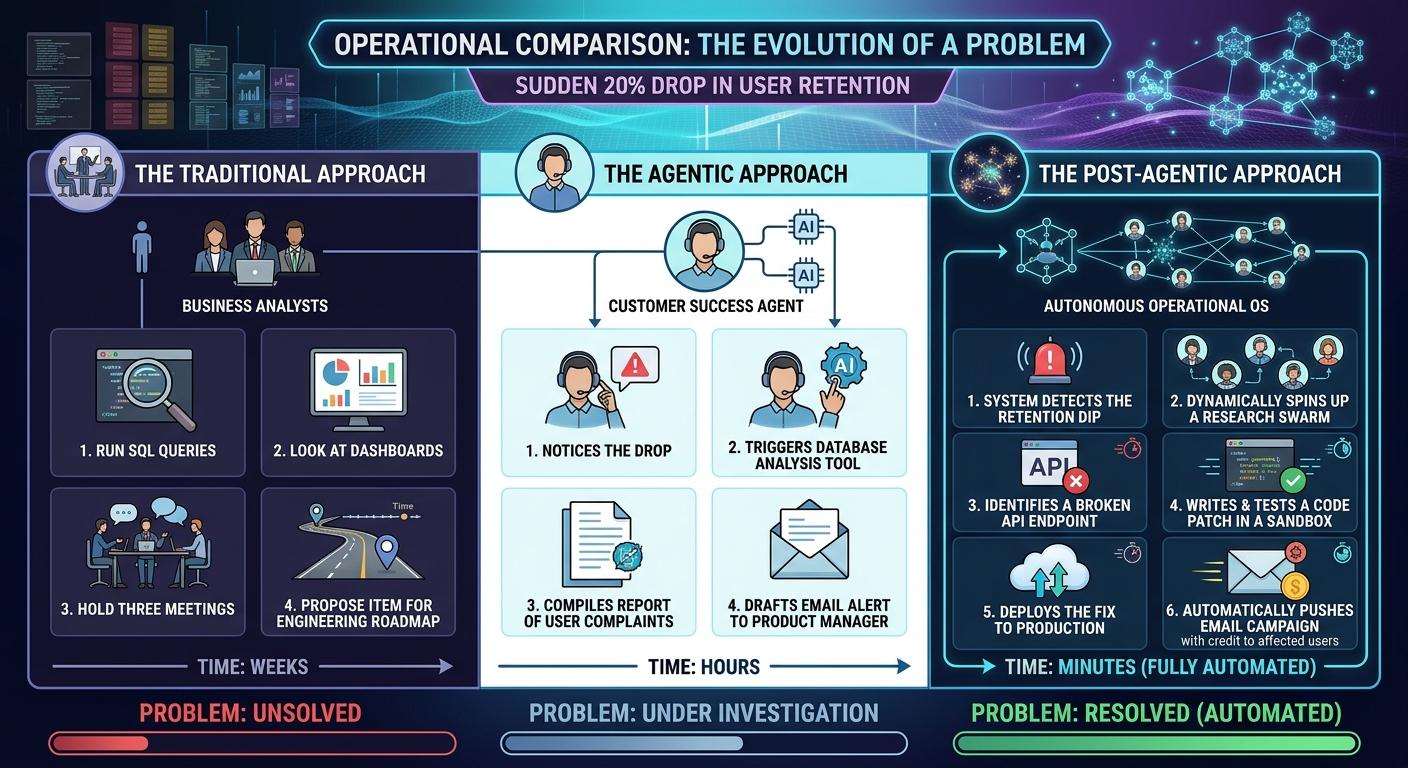
The Post-Agentic AI era
Post-Agentic AI takes this a step further through dynamic epistemic planning.
The Post-Agentic AI era marks the transition from machine automation to systemic evolution.
In the Agentic era, humans are the architects—we write the code, define the roles (like in CrewAI), and hand the AI its tools. In the Post-Agentic era, the AI becomes the architect. It diagnoses problems, creates its own specialized software tools, spins up its own digital workforce, and maintains complex operational systems completely on its own.
Here is a deep dive into the three pillars defining this shift.
1. Dynamically Defining Their Own Steps (Self-Directed Execution)
Traditional coding requires humans to write rigid if/then logic. Agentic AI upgraded this by letting a model use a loop (like ReAct) to figure out how to use tools to hit a goal. Post-Agentic AI takes this a step further through dynamic epistemic planning.
How it works: Instead of following a prompt engineering pipeline, the system treats code and logic as fluid assets. When handed an abstract problem (e.g., "Optimize our global supply chain logistics to handle a sudden port strike"), the AI doesn't rely on a pre-written playbook.
The Evolving Workflow: It spins up isolated code sandboxes, runs thousands of parallel simulations of different logistical frameworks, writes custom optimization algorithms on the fly to handle variables it has never seen before, and deploys the winning script into production. If the environment changes, it rewrites its own operational code in real time.
2. Organizing Their Own Teams (Dynamic Swarm Intelligence)
Right now, developers spend hours configuring agents—giving Agent A a "researcher" backstory and Agent B a "writer" backstory. Post-Agentic systems rely on Generative Orchestration.
               [ High-Level Objective ]
                           │
             [ Core Evolutionary System ]
                           │
      ┌────────────────────┴────────────────────┐
      ▼                                         ▼
[ Spawns Agent #1 ]                      [ Spawns Agent #2 ]
(Autonomously codes its toolset)        (Autonomously assigns its role)
      │                                         │
      └────────────────────┬────────────────────┘
                           ▼
          [ Dissolves Swarm Upon Goal Success ]
On-Demand Specialists: Instead of a fixed crew, the system analyzes a goal and dynamically spawns an ephemeral swarm of specialized sub-agents. It assigns them micro-personas, generates bespoke code toolsets for them, and establishes their communication paths.
Self-Dissolving Networks: These agents work collectively to solve the problem, peer-review each other's outputs, and pass quality checks. Once the objective is completed, the system safely deprecates the entire sub-agent infrastructure to save compute costs.
3. Managing Entire Institutional Frameworks (The Software-Defined Enterprise)
The ultimate manifestation of Post-Agentic AI is the move away from isolated software integrations toward Autonomous Operational Operating Systems. The AI is no longer a tool inside a company; it manages the company’s digital framework.
Self-Correcting Compliance: Instead of waiting for a legal team to audit operations, a post-agentic system constantly monitors changing global regulatory frameworks (such as updates to the EU AI Act). It automatically updates data access permissions, tweaks data routing paths, and flags anomalies before a violation occurs.
Dynamic Resource Allocation: The system monitors corporate overhead, server load, token costs, and departmental efficiencies. It can autonomously reallocate cloud computing budgets, purchase server space, or renegotiate digital API contracts with other autonomous machine networks to ensure maximum efficiency.
#Ai #AiTrends #techinsight #technologymasters #techmasters #techmasterssupport