Get familiar with Ai in 2026
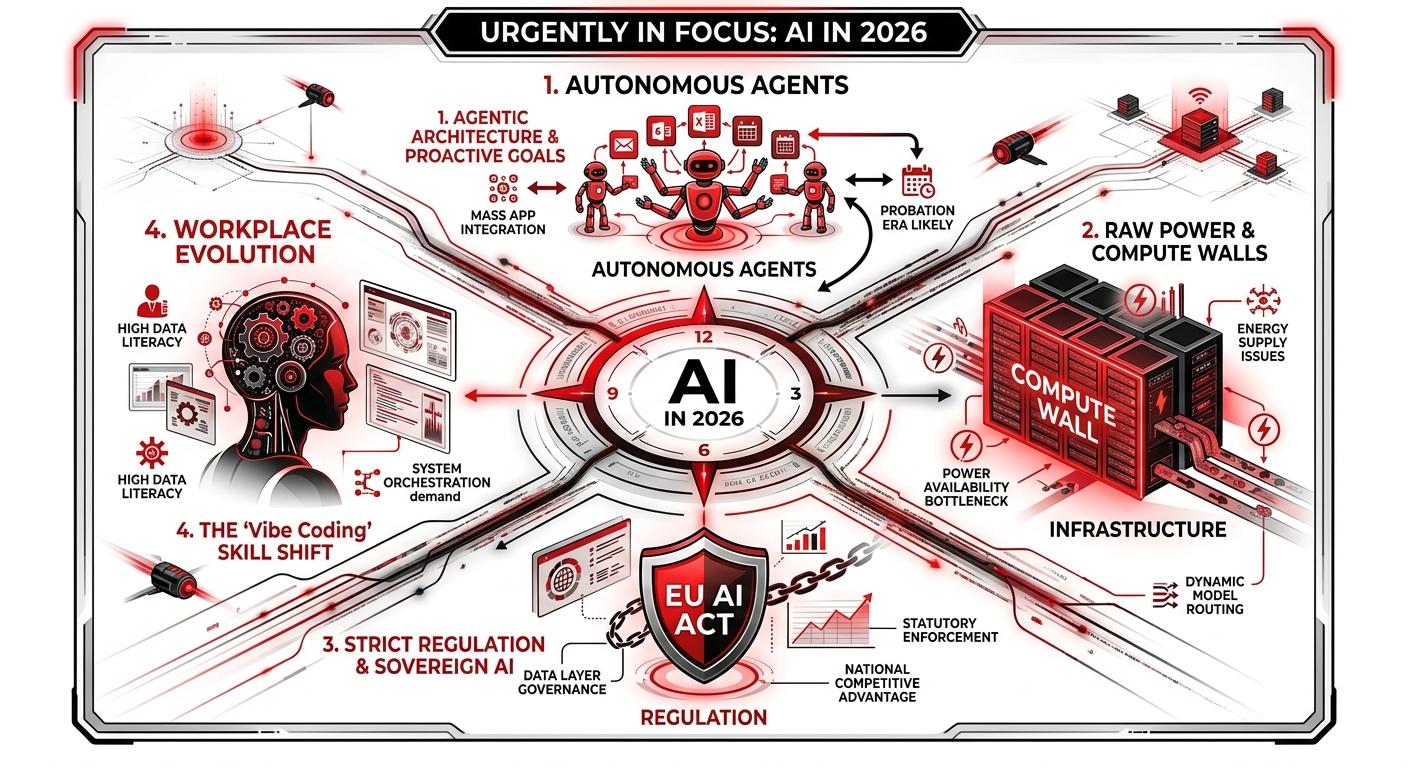
The era of typing prompts into standalone chatbots to copy-paste text is rapidly drawing to a close. AI has moved into a deeply integrated, proactive Agentic Architecture.
In 2026, the artificial intelligence landscape has fundamentally shifted from a phase of novel experimentation to intense operational pressure, infrastructure bottlenecks, and hard-edged regulation. Organizations and individuals are no longer just asking what AI can do—they are urgently solving for how to control it, pay for it, and legally deploy it at scale.
Mass App Integration: Tech giants have natively infused agentic capabilities directly into core work ecosystems (like Gemini in Gmail and automated multi-tool workflows in Google Sheets).
The "Probation" Phase: According to global enterprise findings, roughly 40% of large corporations have scaled autonomous AI agents. However, organizations are realizing that agents only work where data architectures are perfectly solid. Unmanaged or poorly governed agents are facing immediate blowback due to logic errors.
The Compute and Infrastructure Wall
AI development has officially outrun the physical infrastructure supporting it. The urgent conversation is no longer about parameters or model sizes, but about raw power and data centers.
The Energy Bottleneck: Electricity grid capacity and localized power shortages have become the primary limiting factors for frontier model training. Power availability dictates who can successfully scale the next generation of AI systems.
Dynamic Model Routing: To combat soaring token and API operational costs, platforms are shifting heavily toward automated "root LLM" routing. Simple requests are systematically triaged to small, efficient models, while only hyper-complex programming or reasoning tasks are routed to premium frontier models.
Statutory Regulation and "Sovereign AI"
The era of voluntary AI safety pledges and soft-law whitepapers has officially ended. Global governance has transitioned into a rigid, statutory compliance landscape.
The EU AI Act Reaches Enforcment: Major components of the landmark risk-tiered legislation—including strict technical obligations for "high-risk" AI deployments—take full effect. Non-compliance now carries heavy statutory criminal and financial sanctions.
Data Layer Governance: Regulators are targeting technical controls at the data and infrastructure layers rather than trusting prompt-level boundaries. Companies are legally mandated to maintain tamper-evident audit trails, strict least-privilege data access, and verified training data provenance.
Geopolitical Fragmentation: Driven by intensifying trade rivalries, nations are aggressively pursuing "Sovereign AI"—building domestic hardware loops, specialized localized training data sets, and isolated compliance frameworks.
Workplace Evolution & The "Vibe Coding" Shift
As generative adoption crosses the 50% threshold globally, the baseline for required professional skills has completely evolved.
The Technical Skills Mismatch: Standard, basic IT capabilities are seeing flat demand, while market demand has skyrocketed for complex data literacy, advanced information processing, and system orchestration.
Vibe Coding and One-Person Unicorns: High-efficiency developer agents mean non-technical founders can build complex, enterprise-grade software frameworks simply by guiding logic and architecture. The premium is no longer on writing syntactically correct code, but on critical thinking, problem-solving, and strict quality verification.
Follow us for more: https://technmastersltd.com/blog
#TechMasters #Ai #TechMasterSupport #TechInsights #TechTrends #ArtificialIntelligence #FutureOfWork #BusinessInsights