The Evolution of AI: Why Agentic AI is Replacing the Traditional Chatbot
The Evolution of AI: Why Agentic AI is Replacing the Traditional Chatbot If you’ve interacted with a customer service bot recently, you probably know the drill. You ask a questi...
The Evolution of AI: Why Agentic AI is Replacing the Traditional Chatbot
If you’ve interacted with a customer service bot recently, you probably know the drill. You ask a question, the bot scans a database, and it spits back a link to a help article or a rigid set of menu buttons. It’s useful, but it’s limited.
We are currently living through a massive architectural shift in artificial intelligence. We are moving away from Traditional AI Chatbots that simply "talk" and entering the era of Agentic AI—systems designed to "do."
If your business is still relying on basic conversational bots, here is what you need to know about this paradigm shift and why it matters for your digital strategy.
What is a Traditional AI Chatbot? (The "Reactive" Model)
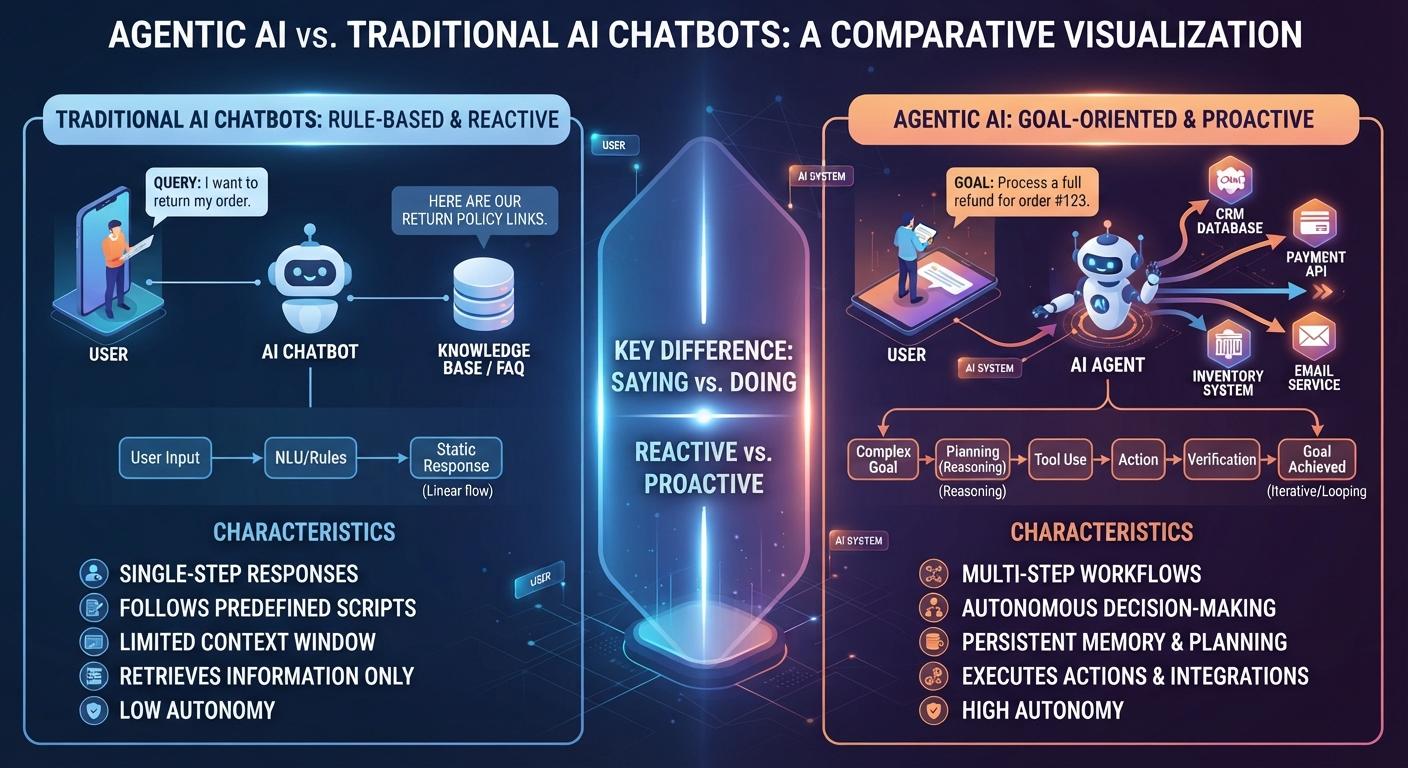
Traditional chatbots—including many early LLM-powered assistants—operate on a linear, reactive model. They are passive tools waiting for a user to input a prompt.
How they work: A user types a query (e.g., "What is your return policy?"). The chatbot processes the text, queries a knowledge base or predefined script, and outputs an answer.
The limitation: They are strictly informational. If a customer says, "I want to return this item," a traditional chatbot can only give them instructions or a link to a form. It cannot actually process the return for them.
What is Agentic AI? (The "Proactive" Model)
Agentic AI systems aren't just conversation partners; they are autonomous digital workers. Instead of waiting for step-by-step instructions, you give an AI Agent a high-level goal, and it figures out how to achieve it.
How they work: You give the agent an objective (e.g., "Process a full refund for Order #123 and update our inventory").
The execution: The agent evaluates the goal, breaks it down into a multi-step plan, selects the right tools, connects to your CRM and payment APIs, executes the action, verifies the result, and loops back if it encounters an error—all without human intervention.
Side-by-Side: Saying vs. Doing
To understand the core differences, let's look at how they stack up across key operational pillars:
FeatureTraditional AI ChatbotsAgentic AICore ValueAnswers questions and retrieves information.Executes complex, end-to-end workflows.Workflow PathLinear: Simple input \(\rightarrow \) output flow.Iterative: Continuous loop of planning, acting, and reflecting.IntegrationLow: Usually isolated to a single chat window or database.High: Deeply connected to external APIs, CRMs, and software ecosystems.AutonomyFollows predefined scripts; easily gets stuck.Self-correcting; adapts if an initial plan or API call fails.
The Secret Sauce: The ReAct Pattern
Why is Agentic AI so much more capable? It relies on an engineering pattern known as Reason + Act (ReAct).
When a traditional chatbot encounters a problem it doesn't know, it breaks down or hands the conversation off to a human. An Agentic AI system runs a continuous logic loop:
Thought: "To refund this customer, I first need to verify their purchase history."
Action: Call the CRM database API.
Observation: "The CRM shows the item was bought 45 days ago. Our policy is 30 days, but this is a VIP customer."
New Thought: "Because they are a VIP, I am authorized to override the window. I will now call the payment processor."
This ability to dynamically reason and switch paths based on real-time data is what makes agents feel truly intelligent.
Which One Does Your Business Need?
While Agentic AI is the future, traditional chatbots still have a place. Choosing the right one depends entirely on your operational goals.
Opt for Traditional Chatbots if:
You only need to handle basic, static FAQs (e.g., store hours, location, shipping rates).
You want a low-cost, low-overhead tool purely for initial lead triage.
Your workflows require zero backend system integration.
Upgrade to Agentic AI if:
You want to automate actual resolutions (e.g., booking flights, troubleshooting software, managing inventory).
Your workflows require orchestrating multiple tools and databases simultaneously.
You want to free your human staff from repetitive administrative tasks so they can focus on high-value strategy.
The Bottom Line
Traditional chatbots changed the way we access information, but Agentic AI is changing the way we work. By shifting the focus from answering questions to executing goals, AI agents are transforming from simple software interfaces into autonomous team members.
The question is no longer whether your AI can talk to your customers—it's whether your AI can actually get the job done.
Follow us for more: www.technmastersltd.com | IG: @techmasterssupport
#Infographic #AgenticAI vs traditional #chatbots and autonomous #workflows #TechnologyMasters #TechMasters